Chu Sai / 出塞
Contemporary Chinese art song after Wang Changling, using textual fragmentation, phonemic decomposition, and non-linear vocal structure.
Instrumental writing, vocal work, chamber music, and compositional systems that transform text, memory, structure, and timbre into musical form.
In his compositional practice, Yuxuan Feng currently takes cross-cultural musical communication as one of his central creative subjects. His work investigates how different musical languages, materials, and listening habits can encounter, translate, and transform one another within a contemporary compositional context.
He is also engaged in the design and practical application of musical structure. Rather than treating structure only as a formal container, he approaches it as a generative field in which elements are arranged, organized, and developed into distinct artistic meanings.
He has a strong, almost instinctive affinity for counterpoint, and is currently researching both counterpoint and its expanded systems. This includes, but is not limited to, pentatonic counterpoint, anti-counterpoint, atonal counterpoint, and contrapuntal systems based on pitch-structural organization.
In terms of timbre, he is interested in the exchange and translation of instrumental techniques across different cultural contexts. At the same time, his work explores the expansion of timbral possibilities within common instruments, including extended techniques, transformed playing gestures, and new relationships between sound, material, and performance.
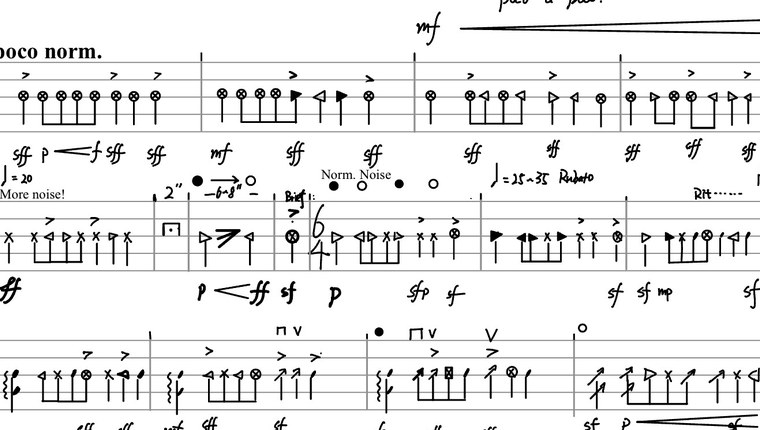
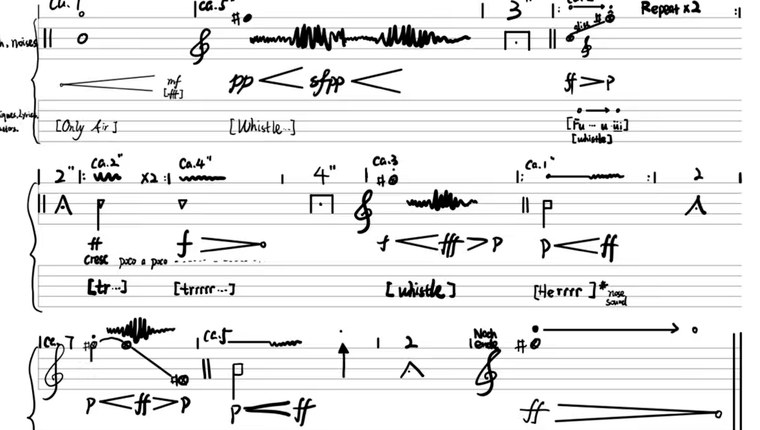
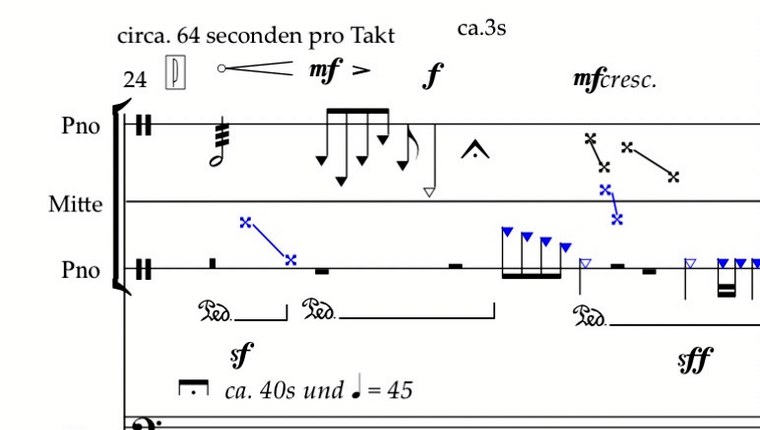
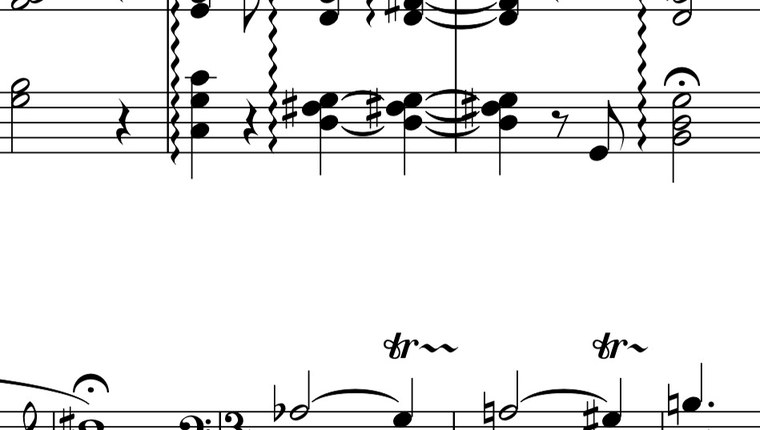
Score fragments are used here as compact demonstrations of gesture, structure, timbre, breath, and material organization within the compositional process.
Contemporary Chinese art song after Wang Changling, using textual fragmentation, phonemic decomposition, and non-linear vocal structure.
Chamber work connected to sensation, recurrence, revision, and the transformation of bodily experience into form.
A work concerned with the refusal of violence, using percussive techniques inside and around the piano to expose sound as impact, residue, and resistance. The piece treats the instrument not as a neutral harmonic body, but as a fragile surface marked by force, memory, and the traces left after collision.